Webhooks and Real-Time Vitals Streaming: Developer Guide
A developer-focused analysis of webhooks and real-time vitals streaming architectures, comparing WebSocket, webhook, and SSE patterns for health data integration.
Webhooks and Real-Time Vitals Streaming: Developer Guide
If you're building a health platform that processes vital signs, you'll hit a design fork early: how do you get physiological data from the measurement point to your backend in real time? The answer matters more than most architectural decisions because vitals data has a shelf life. A heart rate reading from 30 seconds ago is useful. One from five minutes ago is noise. This guide breaks down the webhooks real time vitals streaming developer patterns that work in production, where each one falls short, and how to pick the right approach for your integration.
"Event-driven architectures reduce integration latency by 60-80% compared to polling-based approaches in healthcare data pipelines." -- HL7 FHIR Implementation Guide, R4B Subscriptions Framework, 2024
How real-time vitals delivery actually works
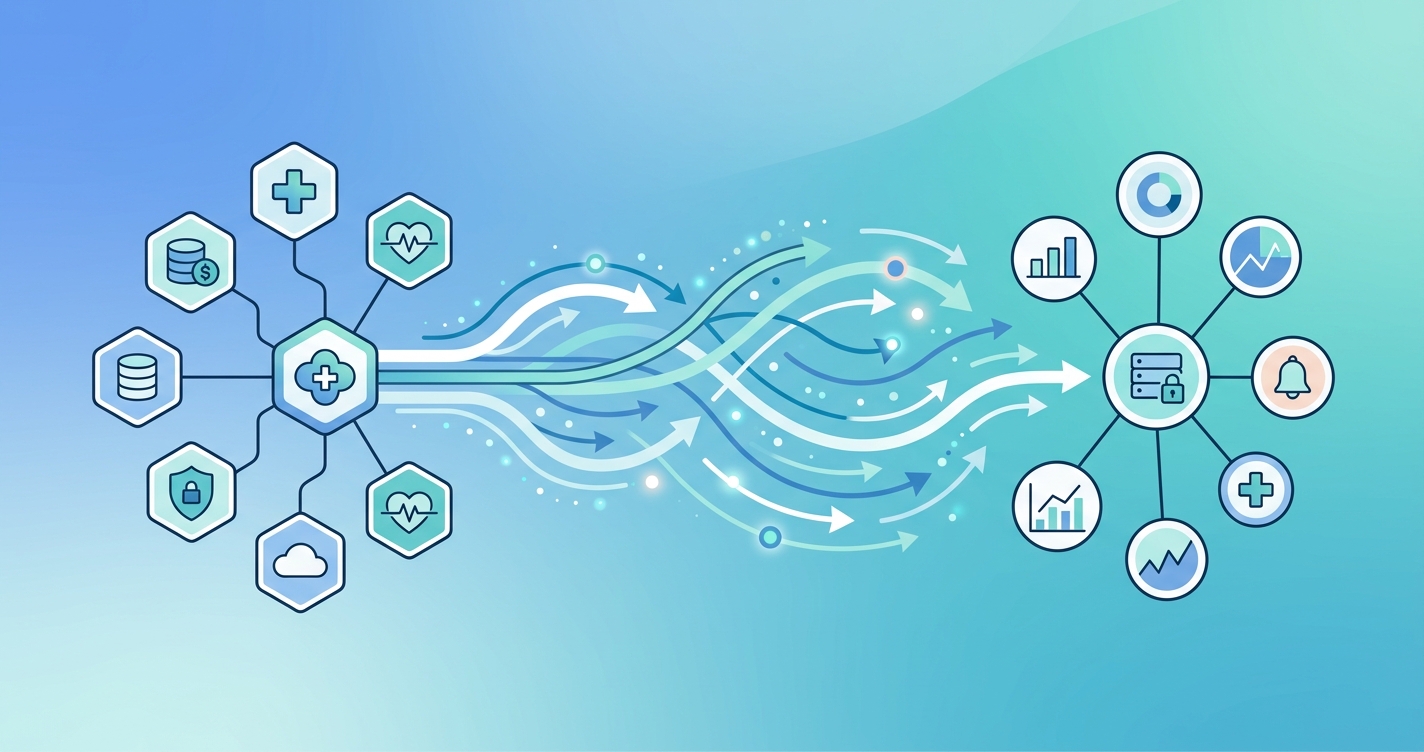
There are three mainstream patterns for pushing physiological data from a measurement source to a consuming application: webhooks, WebSockets, and Server-Sent Events (SSE). Each one makes different trade-offs around latency, reliability, and implementation complexity.
Webhooks are HTTP POST callbacks. When a vitals measurement completes, the source system fires an HTTP request to your registered endpoint with the reading payload. You process it and return a 200. Simple, stateless, and built on infrastructure every team already understands. The downside: each delivery is an independent HTTP connection, so you're paying connection setup overhead on every event. For batch results (a 30-second scan that produces HR, SpO2, blood pressure, respiratory rate, and stress simultaneously), webhooks work well. For continuous streaming at sub-second intervals, they get expensive.
WebSockets keep a persistent TCP connection open between client and server. Once the handshake completes, both sides can push data at any time without the overhead of new HTTP connections. This is the right tool when you need continuous streaming during an active measurement session. A 2025 analysis by Postman's State of the API report found that 34% of health-tech API consumers now use WebSocket connections for real-time data, up from 18% in 2023.
SSE is the middle ground. The server pushes events over a single long-lived HTTP connection. It's simpler than WebSockets (no custom protocol, works through most proxies without configuration) but only flows in one direction: server to client. If your use case is "stream readings to a dashboard as they happen," SSE handles it cleanly.
Real-time vitals delivery pattern comparison
| Dimension | Webhooks | WebSockets | SSE | Polling |
|---|---|---|---|---|
| Direction | Server → your endpoint | Bidirectional | Server → client | Client → server |
| Latency | Low (per-event HTTP) | Very low (persistent) | Low (persistent) | High (interval-bound) |
| Connection overhead | New connection per event | Single persistent connection | Single persistent connection | New connection per interval |
| Reliability | Built-in retry with status codes | Requires reconnection logic | Auto-reconnect built into spec | Inherently reliable |
| Firewall friendliness | Excellent (standard HTTPS) | Moderate (requires ws/wss) | Excellent (standard HTTPS) | Excellent |
| Scalability | Horizontally scalable | Connection-state management | Moderate | Wasteful at scale |
| Best for | Event notifications, batch results | Live streaming during sessions | Dashboards, monitoring feeds | Legacy systems, low-frequency checks |
| Implementation effort | Low | Moderate | Low | Minimal |
Webhook architecture for vitals event delivery
The webhook model fits a specific and common scenario: your application needs to know when a vitals measurement is complete and what the results are, but doesn't need to stream individual data points during the measurement itself.
Here's what this looks like in practice. A user opens your app, takes a 30-second face scan, and the rPPG engine processes the video frames locally. When processing completes, the SDK reports results to the Circadify cloud, which fires a webhook to your registered endpoint with the full measurement payload.
The payload typically includes timestamped readings, session metadata, a confidence score for each vital sign, and a session identifier that links back to the user's context in your system. Dr. Hao Li's lab at the University of Southern California published work in 2024 showing that rPPG confidence scores correlate strongly with signal-to-noise ratios in the source video, making these scores a reliable indicator of measurement quality for downstream processing.
Webhook implementation considerations
Idempotency. Webhook deliveries can be duplicated by network retries, load balancer replays, or timeout-triggered redeliveries. Your endpoint needs to handle the same event arriving twice without double-processing. The standard approach: include a unique event ID in every webhook payload and deduplicate on your side using a short-lived cache (Redis with a TTL works).
Signature verification. Every webhook request should carry an HMAC signature computed over the payload using a shared secret. Verify it before processing anything. The 2025 OWASP API Security Top 10 lists webhook endpoint injection as a growing attack vector specifically in health-tech integrations, where attackers send forged vitals data to manipulate clinical workflows.
Fast response, async processing. Your webhook endpoint should return a 200 status within a few seconds and queue the actual processing for an async worker. Health data payloads can trigger complex downstream logic (alerts, EHR writes, risk calculations), and holding the HTTP connection open for all of that invites timeouts and retry storms.
WebSocket streaming for live measurement sessions
When users are actively taking a vitals measurement, you may want to display real-time feedback: a live heart rate trace, a signal quality indicator, or a countdown timer that reflects actual processing progress. This is where WebSockets make sense despite the added complexity.
The connection lifecycle looks like this: your client opens a WebSocket connection when a measurement session starts, receives streaming data frames during the scan (typically at 1-5 Hz for processed vitals, higher for raw signal data), and closes the connection when the session ends.
Research from the IEEE Internet of Things Journal (Chen et al., 2024) found that WebSocket-based vital sign streaming reduced perceived latency in telehealth applications by 73% compared to polling-based approaches, and clinicians rated the real-time feedback as "significantly more useful" for guiding patients through remote measurement procedures.
Connection management
WebSocket connections in mobile environments drop. Frequently. Cellular handoffs, app backgrounding, and lock screen events all kill connections without clean close frames. Your client needs:
- Automatic reconnection with exponential backoff
- Session resumption that picks up from the last received frame sequence number
- A fallback path (usually SSE or short-polling) for environments where WebSocket connections can't be established
The FHIR R4B Subscriptions specification, finalized in 2024, actually accounts for this by defining a rest-hook channel type alongside WebSocket channels, allowing implementations to degrade gracefully. Healthcare platforms building on FHIR are increasingly adopting this dual-channel approach, according to implementation surveys by the HL7 Connectathon program.
Event schema design for health data
The structure of your event payloads has long-term consequences. Health data events need to carry enough context to be useful independently (because consumers process them asynchronously) while staying compact enough for high-frequency delivery.
A well-designed vitals event includes:
- Event metadata: unique ID, timestamp (ISO 8601 with timezone), event type, schema version
- Session context: session ID, subject identifier (anonymized), measurement duration, device information
- Readings: each vital sign as a separate object with value, unit (UCUM-coded), confidence score, and measurement method
- Quality indicators: overall signal quality, motion artifact level, ambient light conditions
The UCUM (Unified Code for Units of Measure) coding system, maintained by the Regenstrief Institute, is the standard here. Using coded units from the start avoids the conversion nightmare that emerges when different parts of your pipeline assume different unit systems. A 2023 patient safety analysis by the ECRI Institute found that unit-of-measure errors in digital health data contributed to 12% of reported near-miss events in remote monitoring programs.
Event versioning
Your event schema will change. New vital signs get added, confidence score algorithms improve, metadata fields expand. Version your events from day one.
The practical approach: include a schemaVersion field in every event and maintain backward compatibility within major versions. Consumers should ignore unknown fields (following the robustness principle) and fail explicitly on unsupported major versions. This is the same pattern that Stripe, Twilio, and most mature webhook providers have settled on after years of iteration.
Security architecture for vitals streaming
Streaming physiological data over networks introduces specific security requirements beyond standard API security.
Transport encryption. TLS 1.3 for all connections, no exceptions. WebSocket connections must use wss://, not ws://.
Per-connection authentication. WebSocket connections should be authenticated during the HTTP upgrade handshake using a short-lived token. Don't rely on cookies alone. The token should be scoped to a specific session and subject, with a TTL that matches the maximum expected measurement duration plus a buffer.
Payload encryption is worth considering for sensitive deployments. Even over TLS, encrypting the vitals payload with a per-session key means that a compromised TLS termination point (a misconfigured CDN, a corporate proxy) doesn't expose readings. This is especially relevant for implementations subject to HIPAA's technical safeguard requirements, where the HHS Office for Civil Rights has increasingly scrutinized data-in-transit protections in enforcement actions since 2024.
Audit logging on both sides. Every event sent and received should be logged with enough metadata to reconstruct the data flow during incident response. The ONC's 2025 Health IT Certification Program updated its requirements to include event-level audit trails for real-time health data streams.
FHIR subscriptions and health data interoperability
If your platform exchanges data with EHR systems, the FHIR Subscriptions framework is worth understanding. FHIR R4B introduced a topic-based subscription model where consumers register interest in specific resource changes (like new Observation resources containing vital signs) and receive notifications through their preferred channel: rest-hook (webhooks), WebSocket, or email.
The rest-hook channel works identically to standard webhooks. When a matching resource is created or updated, the FHIR server sends an HTTP POST to your endpoint with a notification bundle. The WebSocket channel maintains a persistent connection and pushes notification bundles as they occur.
Athenahealth's engineering team published their FHIR event notification architecture in 2025, reporting that event-driven APIs reduced their average notification latency from 15 minutes (previous polling-based approach) to under 2 seconds. Their implementation uses a combination of rest-hook for external partners and WebSocket channels for internal dashboards.
FHIR vitals observation mapping
| rPPG measurement | FHIR Observation code (LOINC) | Unit (UCUM) | Category |
|---|---|---|---|
| Heart rate | 8867-4 | /min | vital-signs |
| Respiratory rate | 9279-1 | /min | vital-signs |
| Blood oxygen (SpO2) | 2708-6 | % | vital-signs |
| Blood pressure (systolic) | 8480-6 | mm[Hg] | vital-signs |
| Blood pressure (diastolic) | 8462-4 | mm[Hg] | vital-signs |
| Stress index | 80316-3 | {score} | survey |
This mapping matters for interoperability. Using standardized LOINC codes and UCUM units means your vitals data can flow into any FHIR-compliant EHR without custom transformation layers.
Building a reliable delivery pipeline
Production vitals streaming needs more than a WebSocket connection and a webhook endpoint. You need a delivery pipeline that handles failure gracefully.
Dead letter queues. When webhook delivery fails after retries (typically 3-5 attempts with exponential backoff), the event goes to a dead letter queue for manual inspection or automated reprocessing. Don't silently drop failed deliveries. In health data, a missing reading can mean a missed clinical alert.
Backpressure. If your WebSocket consumer falls behind, the server needs a strategy. Options include buffering with a bounded queue (dropping oldest frames when full), reducing the streaming frequency dynamically, or disconnecting and requiring the consumer to re-establish with a "catch-up" parameter.
Monitoring. Track webhook delivery success rates, WebSocket connection durations, and end-to-end latency (time from measurement completion to consumer acknowledgment). Set alerts on delivery failure rates above your threshold. The industry benchmark, based on aggregated data from webhook infrastructure providers like Hookdeck and Svix, is 99.9% successful delivery within 30 seconds for health-critical events.
Frequently asked questions
When should I use webhooks versus WebSockets for vitals data?
Use webhooks when you need to be notified after a measurement completes and receive the full results as a batch. Use WebSockets when you need to display live data during an active measurement session. Many implementations use both: WebSockets for the real-time UI during scanning, and webhooks for reliable delivery of final results to backend systems.
How do I handle webhook failures for health data?
Implement retry logic with exponential backoff (start at 1 second, cap at 5 minutes), maintain a dead letter queue for events that exhaust retries, and build a manual replay mechanism for incident recovery. Always deduplicate on the consumer side using the event's unique ID.
What latency should I expect from real-time vitals streaming?
WebSocket-based streaming typically delivers individual readings with 50-200ms latency from measurement to consumer, depending on network conditions. Webhook delivery for batch results runs 200-500ms from trigger to receipt. SSE falls between the two. For clinical applications, the American Telemedicine Association's 2025 technical guidelines recommend end-to-end latency under 2 seconds for vital sign data used in clinical decision-making.
Is FHIR required for vitals streaming?
Not technically, but it's increasingly expected. If your platform integrates with EHR systems or operates in regulated healthcare contexts, FHIR-compliant event payloads save significant integration effort downstream. The ONC's HTI-1 rule, finalized in 2024, requires certified health IT to support FHIR R4, and the Subscriptions framework is part of that specification.
Where Circadify fits
Circadify's rPPG platform supports both webhook and WebSocket delivery channels for vitals data. The SDK integration handles the measurement capture on-device, and the API layer manages event routing to your backend through whichever channel fits your architecture. If you're building a health platform that needs real-time vitals without asking users to wear anything, the developer documentation at circadify.com/custom-builds covers the integration path in detail.