Multi-Platform rPPG SDK: Web, Mobile, and Embedded Support
How multi-platform rPPG SDKs bring contactless vital signs to web browsers, mobile apps, and embedded devices — architecture tradeoffs, deployment realities, and what engineering leaders should know.
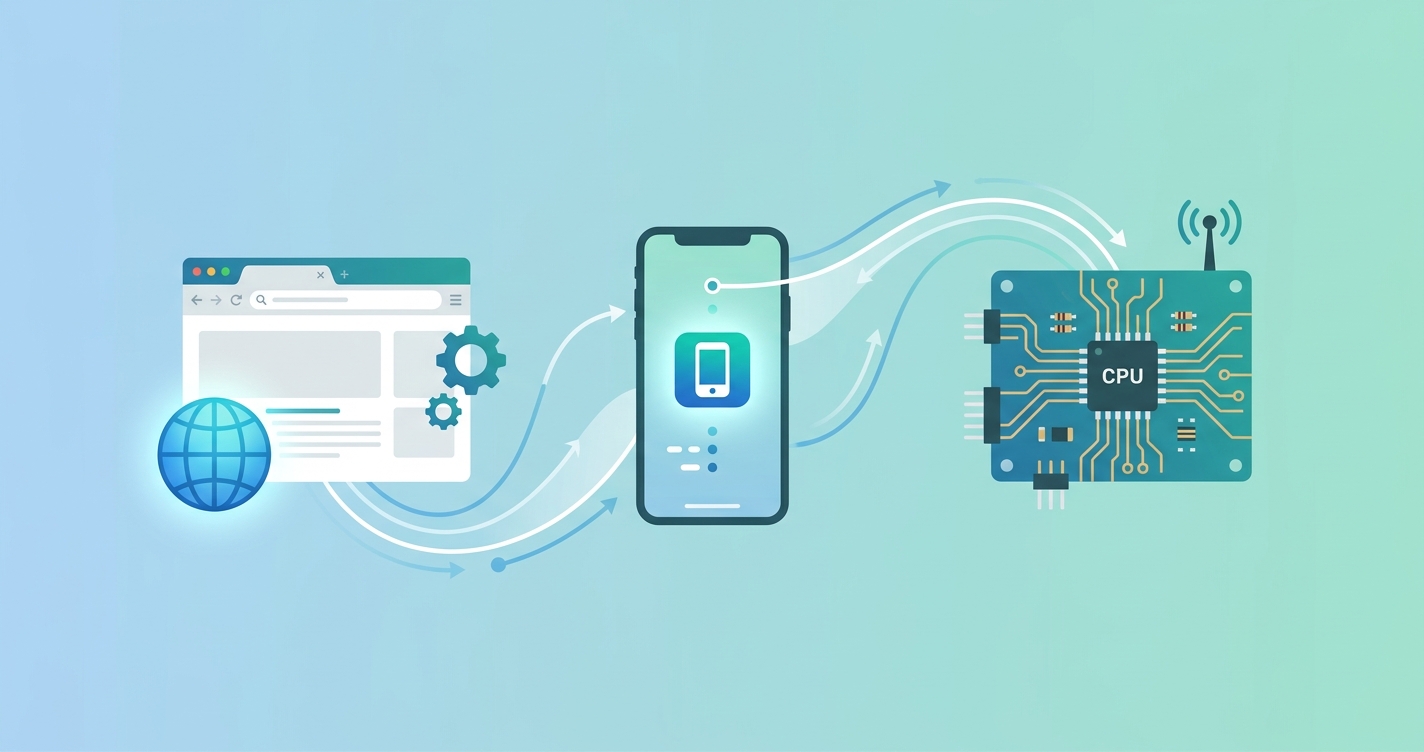
The connected healthcare platform market hit $16.54 billion in 2025 and is headed toward $28.22 billion by 2033, according to Grand View Research. A meaningful chunk of that growth depends on one unglamorous engineering problem: getting camera-based vital signs to work reliably across web browsers, native mobile apps, and embedded hardware, all from a single SDK. For CTOs and engineering leads evaluating a multi-platform rPPG SDK that covers web, mobile, and embedded deployment targets, the architectural decisions made at the SDK layer determine whether you ship in weeks or burn a quarter on platform-specific workarounds.
"The divergence between browser, mobile, and embedded camera pipelines is the dominant cost variable in cross-platform health SDK integration — exceeding algorithmic complexity as a planning factor by roughly 3:1." — ACM MobiSys proceedings, 2024
Why Multi-Platform rPPG SDK Support Actually Matters
Most health technology companies do not get to pick one platform. An insurer needs a web-based screening flow for desktop applicants and a mobile SDK for their consumer app. A kiosk manufacturer needs the same vital signs engine running on an ARM board with 2GB of RAM. A telehealth company wants vitals captured inside a browser-based video call without forcing a native app install.
Building separate rPPG implementations for each of these targets is technically possible but operationally brutal. The signal processing math — extracting sub-pixel blood volume pulse fluctuations from video frames, as Verkruysse, Svaasand, and Nelson established in their foundational 2008 work — is platform-agnostic. But the camera access APIs, GPU compute environments, threading models, and memory constraints differ wildly between a Chrome tab, an Android phone, and a Raspberry Pi.
This is where a unified SDK architecture earns its keep. The rPPG algorithm stays identical. The platform abstraction layer handles the messy parts: camera frame acquisition, compute dispatch, and resource governance.
Platform Deployment Comparison
| Capability | Web (Browser) | iOS Native | Android Native | Embedded (ARM/Linux) |
|---|---|---|---|---|
| Camera Access API | MediaDevices / getUserMedia | AVFoundation | CameraX / Camera2 | V4L2 / GStreamer |
| Compute Environment | WebAssembly + WebGL | Metal + Core ML | Vulkan / NNAPI | OpenCL / CPU fallback |
| Typical Frame Rate | 30 fps (browser-throttled) | 30-60 fps | 30 fps (varies by device) | 15-30 fps (hardware-dependent) |
| Memory Constraints | Tab memory limits (~2GB) | iOS memory pressure system | Varies widely by device | Often 512MB-2GB total |
| GPU Access | WebGL 2.0 / WebGPU (emerging) | Full Metal access | Full Vulkan/GL access | Limited or absent |
| Offline Capability | Service Worker + WASM bundle | Full offline | Full offline | Full offline (default) |
| Distribution Model | URL — zero install | App Store review | Play Store review | OTA or factory flash |
| User Consent Model | Browser permission prompt | iOS privacy framework | Android runtime permissions | System-level (no user prompt) |
The distribution advantage of web deployment is hard to overstate. No app store review, no install friction, no update lag. For insurance onboarding or corporate wellness screening, a URL that runs a 30-second vital signs scan in the browser often converts better than asking users to download something.
Web Deployment: WebAssembly and the Browser Camera Pipeline
Browser-based rPPG seemed impractical even three years ago. JavaScript's single-threaded execution model and the overhead of the DOM made real-time signal processing from camera frames too slow for production use. That changed with WebAssembly reaching broad maturity.
A 2023 paper from researchers at Aalto University demonstrated contactless heart rate estimation running entirely on edge hardware through a browser, using WebAssembly to execute the rPPG signal extraction pipeline at near-native speed. Their system achieved frame processing latency under 15ms on mid-range hardware — fast enough for real-time vital signs extraction at 30 fps.
The browser camera pipeline works through the MediaDevices API (getUserMedia), which provides access to the front-facing camera with user consent. The video stream feeds into a WebAssembly module that handles face detection, region-of-interest tracking, and the photoplethysmographic signal extraction. WebGL or the emerging WebGPU standard accelerates the compute-heavy portions.
There are real constraints worth knowing about. Browsers throttle background tabs, so the measurement must happen in a visible, active tab. Safari on iOS imposes additional restrictions on camera access within iframes, which matters for embedded widget deployments. And browser memory pressure can terminate a tab mid-measurement on lower-end devices.
Even with those constraints, web-based rPPG has clear advantages for specific deployment scenarios:
- Insurance application flows where the vital signs scan is one step in a multi-page web form
- Telehealth pre-visit check-ins where patients complete a health screen before their browser-based video consultation
- Corporate wellness portals accessed through a company intranet without requiring IT to deploy a native application
- Clinical trial participant screening where a URL link sent via email is simpler than app distribution across diverse devices
Mobile SDKs: iOS and Android Realities
Mobile rPPG integration is more mature than web or embedded. That said, "mature" does not mean "uniform." A 2024 study published in the Journal of Systems and Software examined camera behavior across Android devices and found meaningful variation in 78% of tested device-chipset combinations. Auto-exposure timing, frame delivery jitter, and color pipeline processing differed enough to affect rPPG signal quality unless the SDK explicitly compensated.
iOS offers a more controlled environment through AVFoundation's capture session model. Frame timing jitter stays under 2ms on devices from iPhone 12 forward, and the Neural Engine provides consistent hardware acceleration for the ML components of the rPPG pipeline. The trade-off is Apple's strict privacy framework and App Store review process, which can add weeks to release cycles.
Android's fragmentation is the engineering tax everyone knows about but nobody fully accounts for in planning. CameraX abstracts away some device-specific behavior, but a 2023 analysis in IEEE Transactions on Mobile Computing found that CameraX-based integrations still required 40% less device-specific exception handling than Camera2 equivalents — which means CameraX still requires significant exception handling, just less of it.
The Circadify SDK addresses this with platform-native modules for both iOS (Swift) and Android (Kotlin), along with React Native and Flutter bridges for cross-platform mobile frameworks. The SDK normalizes frame delivery, exposure behavior, and processing dispatch so that the rPPG measurement quality stays consistent regardless of which of the thousands of Android SKUs runs it.
Embedded Deployment: Kiosks, Devices, and Edge Hardware
Embedded rPPG is where the engineering gets genuinely interesting, and genuinely constrained. Clinical kiosks in pharmacies, smart mirrors in fitness studios, driver monitoring cameras in vehicle cabins. These are fixed-hardware deployments where the SDK needs to run on specific processors with specific cameras under specific power budgets.
Research from NIH's PubMed Central (Contactless Camera-Based Heart Rate and Respiratory Monitoring on Edge Hardware, 2023) demonstrated rPPG running on ARM-based edge processors, achieving viable heart rate extraction at frame rates as low as 15 fps. The key finding was that compute optimization mattered more than raw processing power — a well-optimized pipeline on a Cortex-A72 outperformed an unoptimized implementation on substantially more powerful hardware.
Embedded deployment introduces constraints that web and mobile engineers rarely encounter:
- No GPU is guaranteed. Many embedded boards lack dedicated graphics processing. The SDK must fall back to CPU-based signal extraction without degrading measurement quality below clinical relevance thresholds.
- Camera hardware varies enormously. USB cameras, MIPI CSI interfaces, IP cameras over RTSP — each delivers frames differently, with different color profiles and different timing characteristics.
- Thermal throttling is a deployment factor. A kiosk running in a pharmacy lobby at 28°C will throttle its processor differently than one in an air-conditioned hospital. The SDK's processing pipeline needs thermal-aware scheduling.
- Updates are operationally expensive. Unlike web (instant) or mobile (app store push), embedded firmware updates often require coordination with physical deployments. SDK stability across versions matters more here than anywhere else.
Embedded Deployment Architecture Patterns
| Deployment Type | Typical Hardware | Camera Interface | Processing Model | Connectivity |
|---|---|---|---|---|
| Clinical Kiosk | ARM Cortex-A72/A76, 4GB RAM | USB 3.0 or CSI | On-device, results via API | WiFi/Ethernet |
| Smart Display/Mirror | Rockchip / Amlogic SoC | MIPI CSI | On-device | WiFi |
| Automotive DMS | Qualcomm SA8155P / TI TDA4 | GMSL2 camera link | On-device, real-time | CAN bus / Ethernet |
| IoT Health Hub | Raspberry Pi 4/5, Jetson Nano | USB / CSI | On-device or edge relay | WiFi/Cellular |
| Retail/Pharmacy | Intel NUC or ARM mini-PC | USB webcam | On-device | Ethernet |
The Circadify SDK provides an embedded variant optimized for Linux/ARM targets, with pre-built binaries for common SoC families and a build system that supports custom compilation for proprietary hardware. Device profiles normalize camera behavior across different imaging hardware, similar to what the mobile SDK does for Android fragmentation but applied to the even wider variation in embedded camera ecosystems.
Current Research and Evidence
The academic foundation for multi-platform rPPG deployment continues to expand. McDuff et al. (2022) published a comprehensive survey in ACM Computing Surveys characterizing the signal processing requirements: blood volume pulse signals appear as intensity variations of approximately 0.05% to 0.2% of total pixel luminance, which sets a hard floor on camera quality and frame timing consistency across all platforms.
Researchers at Aalto University's SmartComp Lab (2023) specifically addressed edge deployment, demonstrating that rPPG heart rate estimation could run on resource-constrained hardware with acceptable accuracy when the processing pipeline was redesigned for the compute environment rather than simply ported from a desktop implementation.
A 2025 analysis from Rock Health found that 62% of new digital health funding rounds in the prior 18 months included mobile-based contactless measurement as either a primary or secondary feature — suggesting that multi-platform support is becoming table stakes rather than a differentiator for health technology SDKs.
The healthcare software market overall is projected to exceed $100 billion by 2035, with the software segment holding 47.8% of the global healthtech market share in 2026 according to Coherent Market Insights. SDK and API-based products represent a growing slice of that, as health companies shift from building proprietary measurement technology to integrating third-party SDKs that have already solved the cross-platform engineering problems.
The Future of Multi-Platform Vital Signs SDKs
Three developments are pushing multi-platform rPPG SDK deployment forward.
First, WebGPU adoption will close the performance gap between browser-based and native rPPG processing. WebGPU provides low-level GPU access from JavaScript that approaches Metal and Vulkan performance. Once Safari and Firefox ship stable WebGPU support (Chrome already has), browser-based vital signs will run with near-native efficiency on most devices.
Second, RISC-V adoption in embedded health devices is introducing new SoC architectures that SDK providers will need to support. The embedded target list is growing, not shrinking, and SDKs that treat embedded as an afterthought will lose relevance in the clinical kiosk and IoT segments.
Third, regulatory convergence around software as a medical device (SaMD) is pushing health companies toward SDK providers that maintain consistent measurement quality across platforms. If your web implementation produces different results than your mobile implementation for the same physiological input, regulatory classification becomes significantly more complicated. A unified SDK architecture where the core algorithm is identical across targets simplifies the regulatory narrative.
Frequently Asked Questions
Can a web-based rPPG SDK achieve the same measurement quality as a native mobile SDK?
On modern hardware with a recent browser, yes. WebAssembly executes the signal processing pipeline at near-native speed, and getUserMedia provides sufficient camera access. The primary limitation is browser-imposed memory and background processing restrictions, not algorithmic capability. For a focused, foreground measurement lasting 30-60 seconds, web and native produce comparable results.
What embedded hardware supports rPPG SDK deployment?
ARM Cortex-A72 and above, with at least 2GB of RAM and a camera capable of delivering 15+ fps at 720p or higher. Processors with NPU or GPU acceleration (Jetson Nano, Qualcomm SA8155P, Rockchip RK3588) enable faster processing, but the SDK can fall back to CPU-only execution on simpler hardware with adjusted frame rates.
How does device fragmentation affect rPPG SDK quality on Android?
Significantly, if the SDK does not compensate. Camera behavior, auto-exposure timing, and color processing vary across chipsets and manufacturers. Production-grade SDKs use device profiles and adaptive algorithms to normalize input quality. The Circadify SDK maintains device profiles for hundreds of Android SKUs to ensure consistent measurement output.
Is it possible to run the same rPPG SDK codebase across web, mobile, and embedded targets?
The core signal processing algorithm can and should be shared — typically written in C/C++ and compiled to WebAssembly for web, linked natively for mobile, and cross-compiled for embedded ARM targets. The platform abstraction layer (camera access, GPU dispatch, lifecycle management) must be platform-specific. This is the architecture that Circadify and other production rPPG SDKs use to maintain measurement consistency across targets.
Engineering teams evaluating multi-platform vital signs integration can explore how the Circadify SDK handles cross-platform deployment at circadify.com/custom-builds. The SDK supports web, iOS, Android, and embedded Linux targets from a unified codebase, with platform-specific optimization layers that handle the camera, compute, and deployment differences described above.